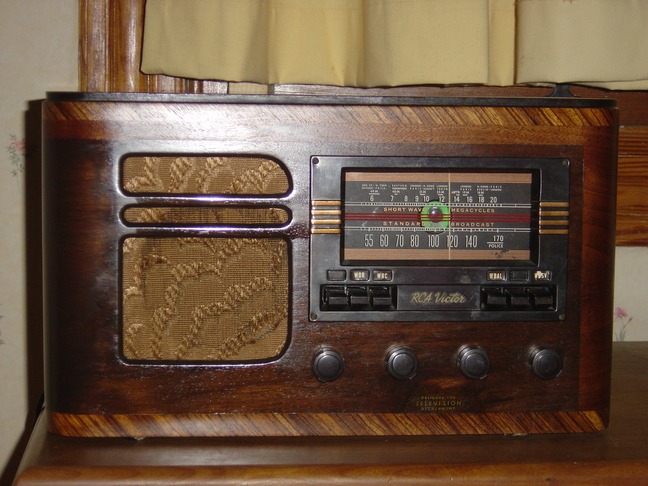
Restored RCA T60
This beautiful little RCA T60 belongs to my friend Clark Day. It was
in pretty bad shape when it got to me, but it now works on both AM and SW
bands. Some of the highlights of the restoration effort were:
- The speaker cone was torn, right up to the rim. I used the
"Elmer's glue" technique
described here. It
worked pretty well.
- The audio output transformer was damaged. It looked like a mouse
had chewed through part of the primary, making a rewind necessary in
order to save it. Instead, I found a metal-clad replacement with the
"exact" footprint at Triode
Electronics. It was listed as "Output Transformer for Add-On
Reverb Unit", so I almost missed it. But, it's exactly what this radio
needed. The part number is
OT-47605 and
is actually made in USA by
Magnetic Components,
Inc.. The price was very reasonable, too.
- The "magic eye" tube, 6U5/6G5, was pretty dim. This is the "rare"
one, but Gary Schneider at "Play
Things of the Past" in Medina, OH had it for a very good price.
- Several of the paper capacitors were literally broken. One of the
leads was loose and would wiggle unnaturally at the cap body when
unsoldered. I replaced those with whatever I had here. That fixed the
audio.
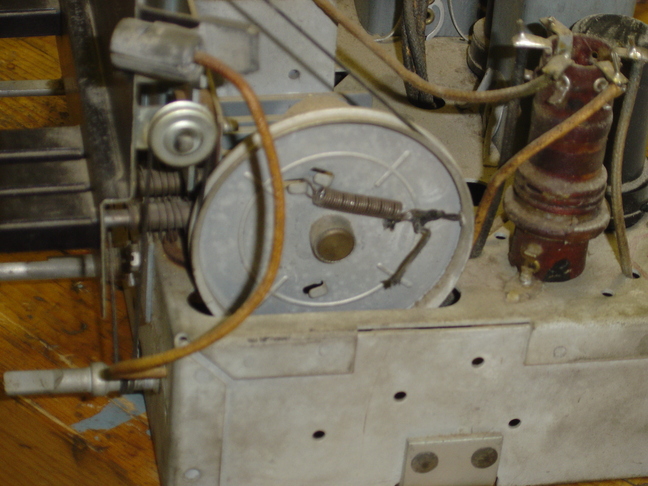
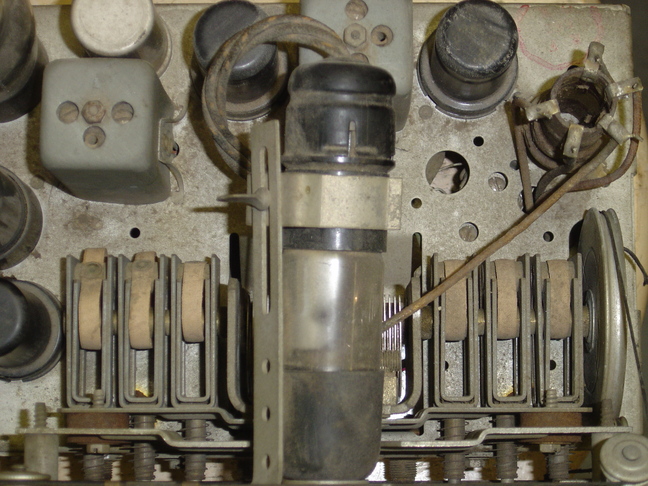
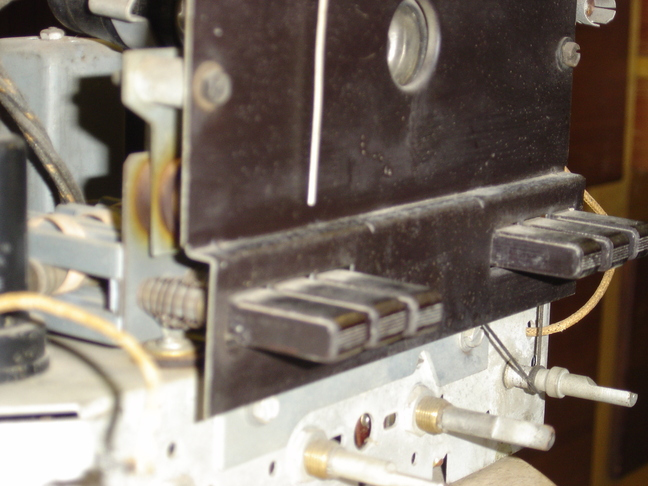
- The push-button dial mechanism was binding. It was pretty easy to
disassemble and re-lube the whole thing. The dual-gang capacitor is
the kind that has little ball-bearings on the shaft. I was able to re-use the dial cord but re-strung it so it would be a little more snug.
- While I was taking the picture for this page, there was a "pop"
and it quit working. At first, it looked like the B+ went away because
the "magic eye" tube went dark. Later, the B+ was back, but not on the
6SA7. The IF transformer had blown open. Coincidentally, one of the
wire leads which goes up into the can had very deteriorated, cracking,
plastic insulation and was bare in spots. I suspect it touched ground
at some point. The fine cloth-covered magnet wire had blown right
where it turned to enter the winding. Some of the fine wire strands
had balled up on their ends, which is pretty strong evidence of fusing. The
repair took a few hours, but it's back and working now.
- The cabinet refinishing was difficult because of the two-tone
staining. I used Watco "Danish Oil" and Minwax "Special Walnut", with
masking tape to define the dark area. I left the "Designed for
TELEVISION attachment" decal intact, so I had to match the original
color. It took several coats but in the end is acceptable. The most
difficult part was then I had to drill new mounting holes for the
speaker (I think what I got was not original) and accidentally
(stupidly) poked through the front. This was after the refinishing was
done. Oops. The damage was just a little splinter, but it took a long
time to fix. After sanding with 320 grit, the little hole was quite
small, but needed to be filled. I finally used Bix "Stain Putty" mixed
with the "Special Walnut" stain and that worked well. This, however,
led to about two weeks of attempts to blend the little sanded area in
with the rest of the dark region. The little area kept growing and
growing, and was generally either too light, or had really dark areas
around its border. I finally got the right amount of stain to hang
on. The light area is still visible, but it's not too bad. I coated
the whole thing by airbrushing with Floquil "Closs Coat" from the
local hobby store.
- The dial light is a 6.3V Type 51 bulb. This is pretty hard to
find, and I looked everywhere. As a long shot, I tried my local
hobby store and they
had them for 75 cents. Amazing.
The schematic can be
found here.
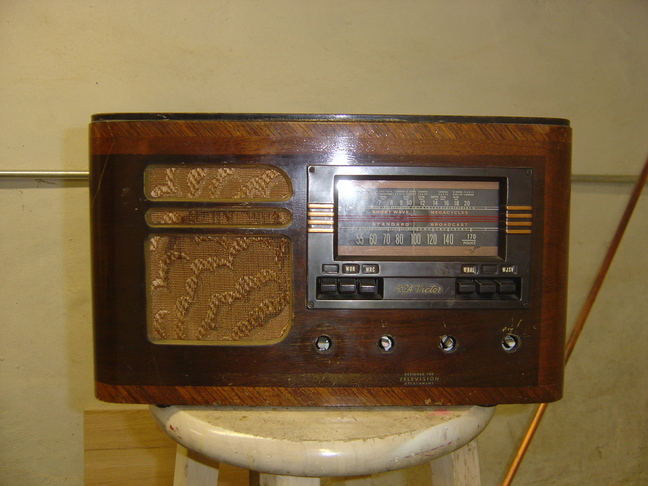
It was very useful. Some pics of the radio before the restoration,
along with some of the insides:
Last updated Mar 30 2010 by richley